

Top leader’s visit to deepen Vietnam-Japan strategic cooperation: expert
The upcoming visit to Japan by General Secretary of the Communist Party of Vietnam Central Committee and President To Lam is expected to give fresh impetus to the Vietnam-Japan Comprehensive Strategic Partnership, reflecting the strategic priorities of both countries, according to a Japanese expert.
Tokyo (VNA) - The upcoming visit to Japan by General Secretary of the Communist Party of Vietnam Central Committee and President To Lam is expected to give fresh impetus to the Vietnam-Japan Comprehensive Strategic Partnership, reflecting the strategic priorities of both countries, according to a Japanese expert.
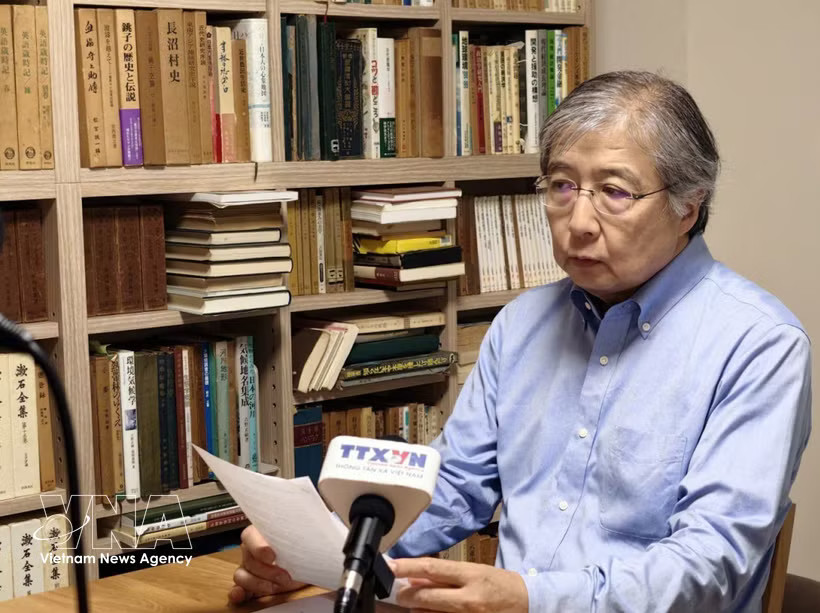
In an interview with the Vietnam News Agency (VNA)'s correspondent in Japan ahead of the visit, Toshiro Nishizawa, a Senior Fellow at Graduate School of Public Policy under the University of Tokyo, highlighted its significance, prospects for bilateral cooperation and contributions of the two nations to regional peace, stability and sustainable development.
He said Japan’s key objective is to advance practical economic security cooperation with Vietnam, one of its most trusted partners. Japan, he noted, is shifting toward a model in which the public and private sectors share risks in areas like energy security and critical minerals, and Vietnam is an ideal partner for that.
For Vietnam, the visit fits into a broader strategy of diversifying its substantive partnerships, especially as it prepares to host the APEC Economic Leaders' Week (APEC 2027) next year.
Strengthening ties with Japan while maintaining stable relations with China reflects Vietnam’s balance and consistent foreign policy, he noted.
The timing of the visit is also of strategical significance, he said, noting that by coming just before APEC 2027 and ASEAN-related meetings, the two sides can highlight their bilateral cooperation within broader regional discussions on supply chains, energy transition, and non-traditional security.
According to the expert, Japan seeks to present its support for the Nghi Son Refinery and cooperation in critical minerals as components of its economic security model. Vietnam, meanwhile, aims to attract high-quality Japanese investment and technology while demonstrating that its partnership diversification strategy is stable and non-confrontational.
For the foundations of bilateral ties, Nishizawa said significant progress in recent years have paved the way for the visit. Under the administration of Prime Minister Kishida Fumio, the two countries elevated their relationship to a Comprehensive Strategic Partnership for Peace and Prosperity in Asia and the World, opening up opportunities for cooperation in economic security, semiconductors, rare earths, energy transition, maritime security and more advanced forms of official development assistance (ODA).
Frequent dialogue at the leadership level has deepened mutual trust, he said, stressing that with political, economic and security cooperation frameworks firmly established, the top Vietnamese leader’s visit represents another step in building a long-term partnership to which both sides are committed to advancing.
Regarding new cooperation drivers, Nishizawa said digital transformation, green transition, advanced technologies, semiconductors, and high-level human resource development are interconnected, with advanced technologies offering the greatest potential to drive the bilateral relationship forward.
According to the expert, cooperation in green transition has already gained momentum through frameworks like the Asia Zero Emission Community (AZEC) and the Joint Crediting Mechanism (JCM). Vietnam’s push toward net-zero emissions creates demand for Japan’s high-efficiency equipment and power grid technologies. The two countries also have potential to expand projects on ammonia, biomass, hydrogen, and circular economy across ASEAN.
Semiconductors and digitalisation also hold strong promise as the two sides have complementary strengths, he said, noting that Japan has strengths in advanced technologies and regulatory systems, while Vietnam boasts rapidly growing design centres and digital talent.
However, Nishizawa pointed to challenges, including project fragmentation and shortages of highly skilled engineers. He said that these can be managed if both governments commit to long-term roadmaps and joint flagship projects, while respecting private-sector initiatives.
At the regional and international levels, he said the visit will help strengthen the foundation for Vietnam and Japan to make greater contributions to peace, stability and sustainable development in the Asia-Pacific through APEC, ASEAN-related meetings and other international frameworks.
Vietnam continues to pursue a foreign policy that prioritises regional stability while seeking a broader and more comprehensive partnership with Japan, he noted, adding that Japan is well positioned to meet that expectation.
The expert expressed his hope that cooperation between the two nations will deepen not only bilaterally but also through regional and international mechanisms, so the Comprehensive Strategic Partnership for Peace and Prosperity in Asia and the World can translate into even more concrete forms of collaboration./.