

Investment support should be linked to verifiable and publicly transparent results
During the National Assembly discussion on the draft Law amending and supplementing a number of articles of the Investment Law, National Assembly Deputy Nguyen Thi Viet Nga (Hai Phong City) proposed adding to Clause 4, Article 17 the principle of distinguishing between mandatory conditions for enjoying policies and committed targets that can be implemented in stages or categories, to avoid situations where failure to meet one target leads to the recovery of support for independent items that have already been implemented correctly.
The delegates also proposed adding to Article 17a the principle of publicly disclosing minimum information about the beneficiaries of support, objectives, funding amounts, and implementation results.
Verify the output results and take appropriate action commensurate with the severity of the violation
After studying the draft Law dated October 30th and the Ministry of Finance 's Report on Acceptance and Explanation No. 893, delegate Nguyen Thi Viet Nga offered suggestions on two issues to ensure that investment attraction policies create tangible spillover benefits while effectively utilizing state resources.
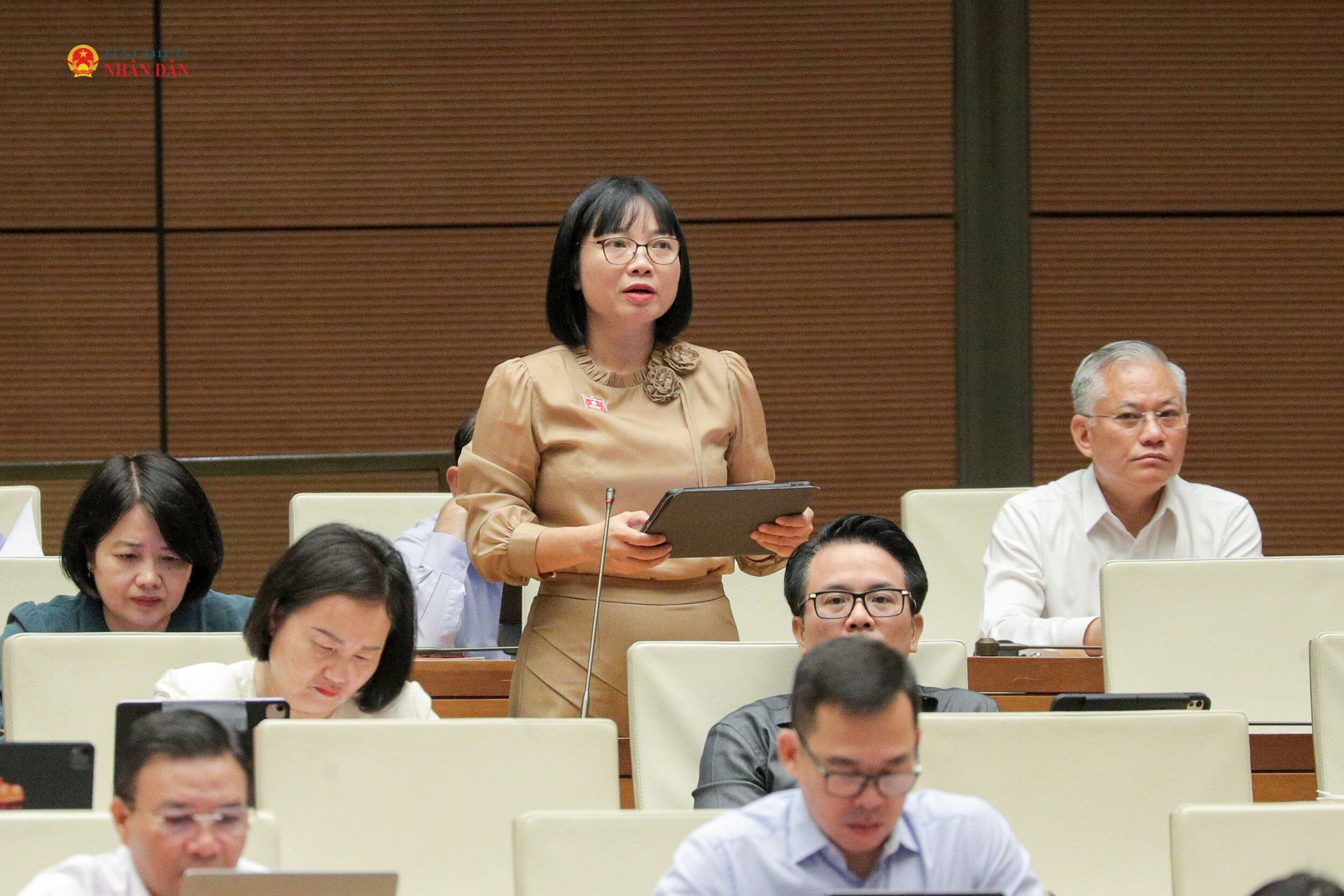
Regarding the verification of results and handling of non-fulfillment of commitments when receiving special investment incentives and support under Article 17, delegates agreed that the drafting agency had clarified the support mechanism, the responsibility for proving eligibility, the evaluation of dossiers, and the monitoring of implementation. Point c of Clause 4 also changed from "consideration for revocation" to "revocation" when investors do not meet the criteria, conditions, or fully fulfill their commitments. However, to ensure consistent application of this mechanism, delegates suggested further refinement of two aspects.
Firstly, it is necessary to clearly define the outputs, the verification timeline, and the responsibilities for confirmation for each commitment group. According to the delegates, the draft stipulates support based on the results of commitment implementation and assigns the Government the authority to provide detailed regulations. The issue is that when deciding on support, the parties involved must clearly understand what results need to be achieved, when they will be evaluated, and which agency is responsible for confirmation.
"Training costs with sufficient documentation do not automatically prove that workers have achieved the committed skills. Consulting and technical improvement costs incurred legitimately do not automatically prove that domestic enterprises have improved their production capacity. Regarding technology transfer, the results should be evaluated based on the recipient's ability to receive, exploit, and utilize the technology," the representative analyzed.
Therefore, the delegates proposed clarifying the content of Article 17, which assigns the Government the authority to regulate the details of determining outputs, methods, timing of verification, and the certifying entity for each type of support. These requirements must be specified in the dossier serving as the basis for support decisions, helping businesses anticipate their obligations and providing implementing agencies with a basis for consistent evaluation.
Regarding support for domestic businesses participating in supply chains under point d, clause 6, the delegate suggested prioritizing the verification of results within the scope of commitments, such as the capacity to meet technical standards, inspection, design, and management. According to the delegate, securing a supply contract also depends on the market and the buyer's decision, so it is necessary to distinguish between the results of capacity building and subsequent commercial outcomes.
Secondly, it is necessary to distinguish between mandatory conditions for enjoying the policy and committed targets that can be implemented in stages or categories. The representative stated that point c, clause 4 stipulates recovery when the investor "fails to fully fulfill commitments," while the explanatory report states that the support level is determined based on actual costs and the extent to which the conditions are met. Therefore, the principle for determining the scope of recovery needs to be clarified.
"If the mandatory conditions for receiving the policy are not met, the improperly received funds must be recovered. However, for targets that can be separated by stages or categories, the corresponding support amount that needs to be adjusted or recovered must be determined; avoiding a situation where failing to meet one target leads to the recovery of support for independent items that have been properly implemented," the representative clarified.
The delegate proposed adding this distinguishing principle to Clause 4, entrusting the Government with specifying the method of determination; cases of fraudulent declaration must be dealt with severely. According to the delegate, clearly defining this would both protect the budget and limit arbitrary application, creating confidence for investors to fulfill their commitments.
Competition to attract investment should be based on quality and transparency in funding
Regarding the control of competition in attracting investment among localities and the transparency of support funds, delegate Nguyen Thi Viet Nga stated that Article 17a, after discussion in the working group, has been revised to clearly limit the scope of support for labor training from local budgets, with a common ceiling and requirements that are consistent with the budget balance capacity.
Regarding the investment attraction orientation in Articles 49 and 49a, delegates proposed linking the requirement for regional linkages with specific monitoring and evaluation responsibilities; assigning a focal agency to synthesize local support policies, assess inter-regional impacts, and promptly recommend handling inappropriate policies or implementation methods.
"The effectiveness of attracting investment needs to be evaluated in terms of project quality, land and resource utilization efficiency, budget, and contribution to the region's value chain. This mechanism will encourage localities to compete through infrastructure, human resources, public services, and collaborative responsibility; limiting the pursuit of a large number of projects and capital attracted to each area," the delegate emphasized.
Regarding training support from local budgets, the representative stated that the explanatory report cited the legal requirements for transparency in budgets and auditing; and also argued that disclosing the specific businesses and support levels could affect business information and negotiation opportunities.
The delegate suggested distinguishing between information under negotiation and approved support decisions and actual disbursed funds. Even after a decision, information requiring protection may still exist, but that information needs to be specifically identified. Accordingly, it was proposed to add to Article 17a the principle of publicly disclosing minimum information about the recipients of support, objectives, funding amounts, and implementation results; excluding information already protected by law. At the same time, it is necessary to ensure that competent supervisory and auditing agencies have full access as prescribed; and to entrust the Government with the authority to regulate the content, timing, and form of public disclosure, avoiding duplicate reports.
"Proper transparency will help control duplicate support, assess the effectiveness of budget utilization, and create a basis for localities to adjust policies and improve the quality of investment attraction," emphasized delegate Nguyen Thi Viet Nga.